

This is a real Facebook Ads Case Study Health Brand India — documented with verified Shopify data, real campaign numbers, and zero edits. What you are about to read is exactly what happened, what was broken, and how it was fixed.
The sessions were there. Add-to-carts were happening. The Meta ads were running.
But orders were not coming in consistently — and nobody in the team could explain why.
This is one of the most common situations I see with health and wellness brands running Facebook Ads in India. Everything looks like it is working on the surface. The dashboard shows traffic. The agency report shows reach and impressions. But revenue tells a completely different story.
When this health brand came to me, they had already been through the standard advice cycle. Increase the budget. Test new audiences. Change the creatives. Try different interests. None of it worked.
I told them to stop touching the ads for two weeks. That suggestion made them uncomfortable — because what I was really saying was that the problem is not where you think it is.
This Facebook Ads case study for a health brand in India documents exactly what I found, what we fixed, and what happened to the numbers over 90 days. Real Shopify data. No edits.
Most brands in a situation like this want a new audience to test. A new creative format. A new budget structure.
What they do not want to hear is that their offer is weak, their product page is broken, and their campaign objective is wrong.
That is harder to accept. Fixing audiences takes an afternoon. Fixing your offer and your page takes real work — and it means admitting something was wrong from the start.
But that is exactly the conversation I had with this brand. And to their credit, they listened.
The industry told them to increase budget. Their previous agency told them to test new audiences. I told them to stop touching the ads for two weeks. Sometimes the most valuable thing you can do is stop making the problem worse before you fix it.
When I audit a Meta ads account for the first time, I do not start with creatives or audiences. I start with the foundation — tracking, campaign structure, and the offer itself.
In most underperforming accounts, something is broken before I even get to the interesting parts. In this case, four things were wrong simultaneously.
The campaign was optimising for traffic — not purchases. The pixel was firing and sessions were being recorded. But Meta was finding people who click, not people who buy. Those are two entirely different audiences and Meta treats them that way. One change here creates an immediate shift in the quality of traffic arriving at the product page.
If you cap your cost per purchase too aggressively before the algorithm has enough conversion data, it will never exit the learning phase. The ads run, the budget spends, but the machine never finds its rhythm. This is one of the most expensive mistakes I see repeated constantly in Indian D2C ad accounts.
No reviews with photos. No ingredient transparency. No money-back reassurance visible above the fold. Health products require a different level of trust than fashion or electronics. A person buying a health supplement for the first time is asking three questions simultaneously — does it work, is it safe, and will I get my money back if it does not. If any of those go unanswered on the page, they leave.
Not fake urgency — real urgency. A genuine reason to buy today instead of saving the tab for later. And risk removal means the customer feels safe making a first purchase from a brand they have never bought from before. Neither existed in the original offer.
We fixed all four. No new budget. No new audiences. Just fixed what was already broken.
Here is what the Shopify dashboard showed at the end of 90 days. This is actual platform data — not an agency slide with selectively chosen date ranges.
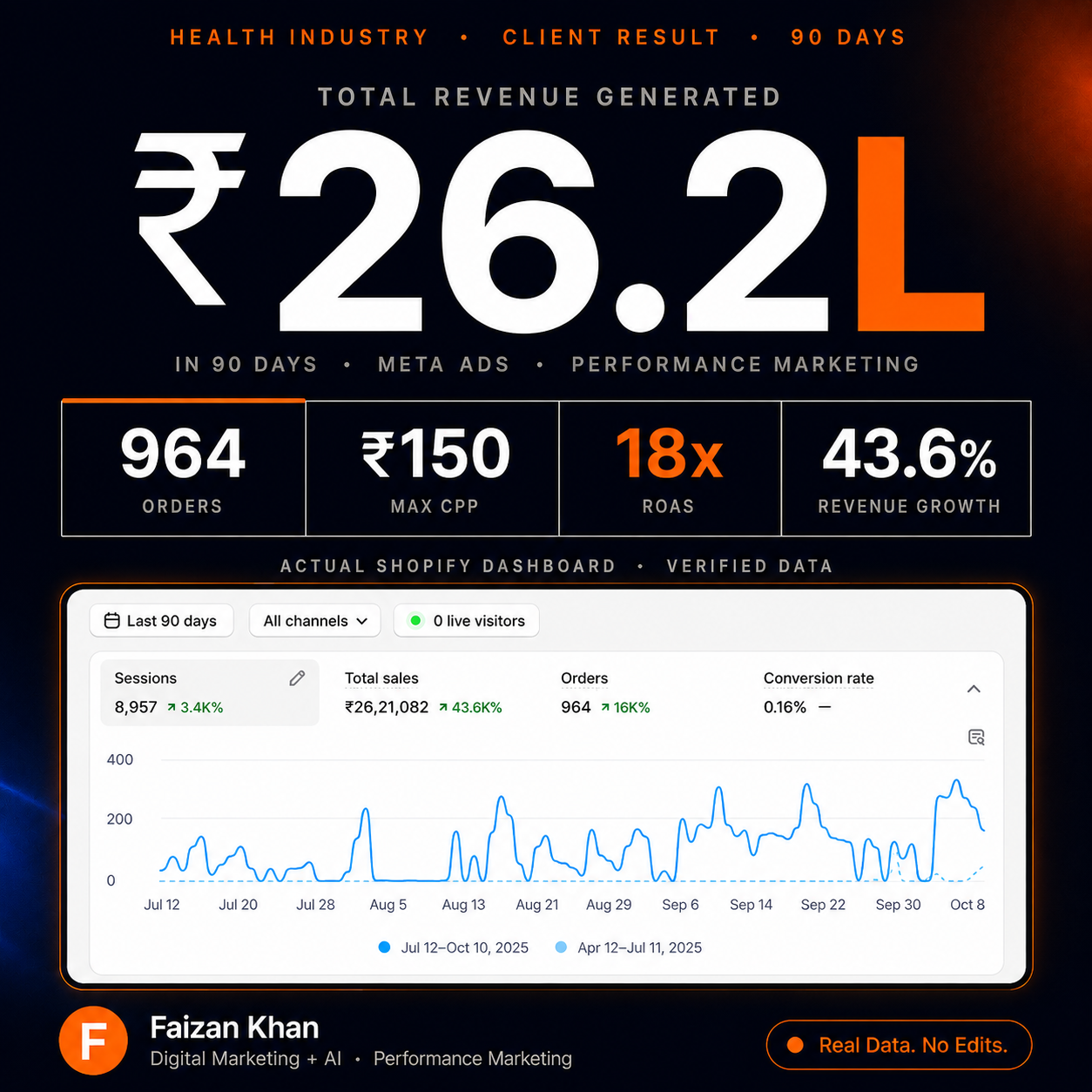
| Metric | Result |
|---|---|
| Total Revenue | ₹26,21,082 |
| Total Orders | 964 |
| Total Sessions | 8,957 |
| Revenue Growth | 43.6% |
| Max Cost Per Purchase | ₹150 |
| ROAS | 18x |
| Total Ad Spend (90 days) | ~₹1,40,000 |
Sessions grew 3.4%. Orders grew 16%. Revenue grew 43.6%.
Think about that for a moment. Traffic barely changed. Conversions did everything.
The budget for this entire 90-day period was approximately ₹1.4 lakh. The return was ₹26 lakh. That is not a trick. That is what happens when you fix the foundation before amplifying the spend.
As a Facebook ads expert in India working with D2C brands across the country, I see this pattern repeatedly — broken foundations dressed up with increasing budgets is one of the most expensive mistakes Indian health brands make.
Health and wellness is one of the most difficult categories to run Meta ads in — and most brands underestimate this completely.
Buyers have been burned before. They have ordered supplements that did nothing, paid for wellness products that arrived looking nothing like the photo, and dealt with brands that disappeared when they asked for a refund. The Indian health buyer in 2025 is educated, careful, and slow to trust.
Which means trust is the product before the product is the product.
Meta has tighter policies around health content. Claims about treating or curing conditions can get ads rejected or accounts flagged. Your creative strategy needs to focus on lifestyle transformation, customer proof, and social validation — not clinical or medical claims. Most brands learn this lesson after a rejected ad or a flagged account.
Someone buying a kurta decides in 30 seconds. Someone buying an ayurvedic liver supplement takes 3 days. Your retargeting window must reflect that reality. If your retargeting window is set to 3 days for a health product — you are abandoning buyers who were genuinely interested but not ready yet.
Most agencies apply the same playbook they use for fashion or electronics and wonder why the results do not transfer.
Moved from a traffic campaign to a purchase-optimised campaign. Meta now had the correct signal to find the right people. One change. Immediate improvement in the quality of traffic arriving at the product page.
Removed the aggressive cost cap during the learning phase. Let Meta gather 50+ purchase events per ad set per week before introducing cost controls. The learning phase is real — do not try to shortcut it.
Added real customer reviews with photos. Made the ingredient list clear and prominent. Added a 30-day return policy above the fold. Added a short “who this is for” section so the right buyers could self-qualify before adding to cart.
No fake countdown timers. A genuine limited batch offer tied to sourcing, and a first-order satisfaction guarantee. The urgency was real. The risk removal was real. Conversion rate on cold traffic improved within the first two weeks.
More budget does not fix a broken funnel. It amplifies it.
Every rupee you add to a campaign with the wrong objective, a product page with no trust signals, and an offer with no reason to act today — is a rupee spent sending qualified traffic to a page designed to lose them.
This is the pattern I see when I work as a best digital marketer in Bareilly and across India. The ads are fine. The targeting is fine. The creative is fine. The foundation is broken.
The industry will always tell you to spend more. A new audience segment, a new creative format, a higher daily budget — because spending more is easier to sell than “your product page needs work.”
The brands that win on Meta are the ones willing to look at the boring stuff first — the pixel setup, the page experience, the offer logic, the CPP targets — before they touch anything exciting.
Health, wellness, and ayurvedic brands specifically need to understand: you are not selling a product. You are asking someone to trust you with their body. That requires a different standard of marketing entirely.
As a digital marketing consultant in India, the first thing I check in any underperforming account is not the creative — it is the conversion layer. That is almost always where the real problem lives.
If your sessions look fine but your orders don’t — the problem is in your conversion layer, not your traffic layer. I know exactly what to look for because I have diagnosed this pattern enough times to find it fast.
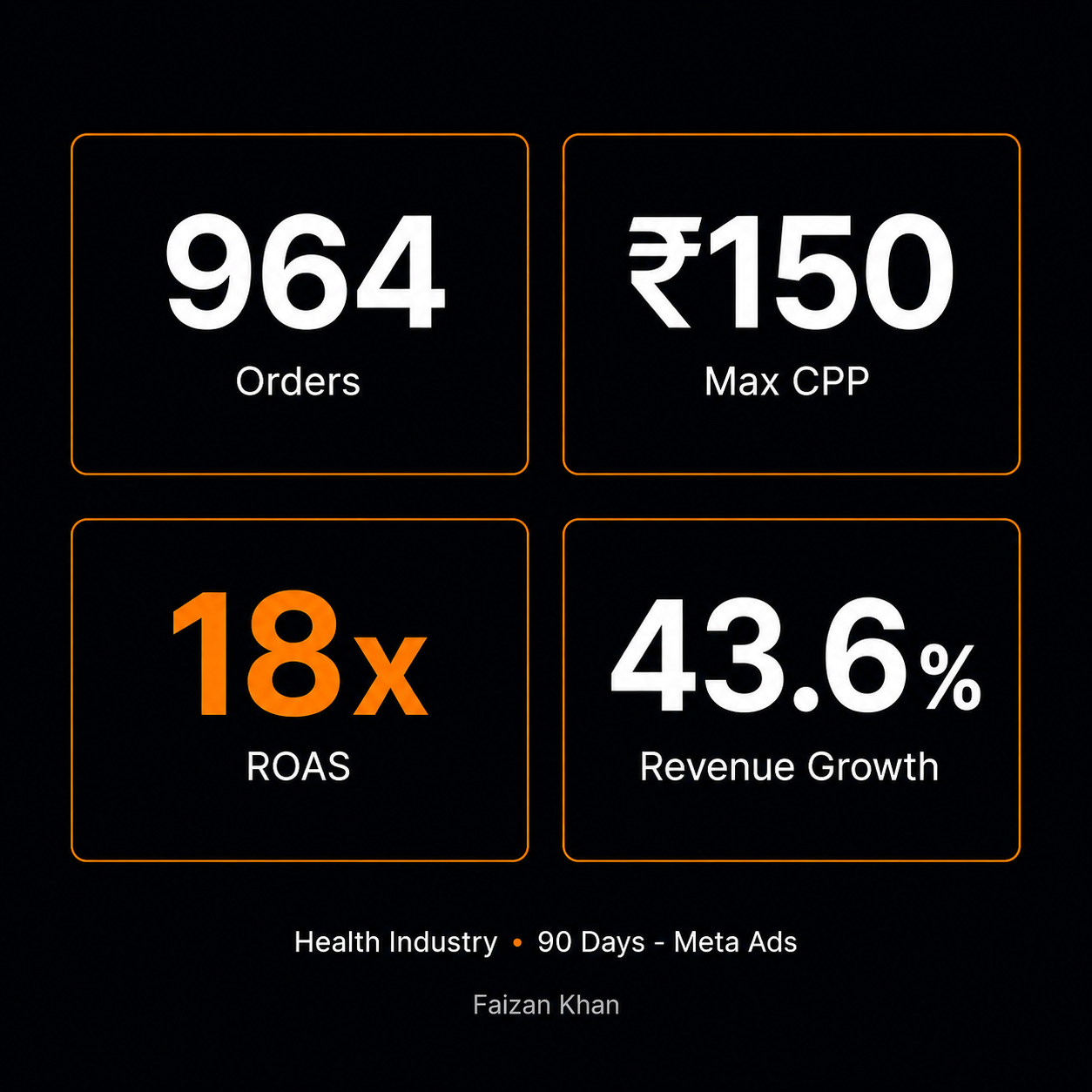
The total Meta ad spend over 90 days was approximately ₹1.4 lakh. The revenue generated was ₹26,21,082 — giving an 18x ROAS at a maximum cost per purchase of ₹150. This was achieved not by increasing budget but by fixing four specific issues in campaign structure, product page trust, and offer mechanics.
Health brands face higher buyer scepticism, longer decision cycles, and stricter Meta policies than most other categories. Most campaigns fail because they apply a generic e-commerce playbook to a category that requires trust-first marketing. The offer, the product page, and the retargeting window all need to reflect the health buyer’s specific psychology.
For a D2C health brand in India, a 4x to 8x ROAS on cold traffic is a reasonable benchmark. The 18x figure in this case study was the result of strong product margins, a rebuilt product page, the correct campaign objective, and a tested offer. It is not a standard benchmark — margins and product price point determine what is achievable.
The learning phase alone takes 1–2 weeks with sufficient daily budget and correct campaign structure. Meaningful conversion data usually emerges by week 3 to 4. Sustainable, scalable results take 60–90 days minimum. Anyone promising results faster is either working with an already-optimised account or setting unrealistic expectations.
I look at three things before anything else — purchase conversion tracking setup, campaign objective, and the product page experience. In my experience, one of these three is broken in the majority of underperforming accounts. Creatives, audiences, and budgets come after. Fix the foundation first.
Yes. While Faizan Khan is based in Bareilly, he works with D2C health, wellness, and ayurvedic brands across India through online consulting and performance marketing. The work in this case study was for a brand outside Bareilly. Geography does not limit the work — results do.
This Facebook Ads case study for a health brand in India is not about a magic strategy or a secret formula. It is about doing the unglamorous work — the pixel audit, the page trust review, the offer logic check — before touching anything the client found exciting.
The health and wellness buyer in India is smart. They have seen enough ads to know when a brand is genuinely worth buying from versus when a brand is just trying to sell them something. The brands that figure out the difference are the ones that build something real on Meta.
If you are running ads for a health, wellness, or ayurvedic brand and your sessions look fine but your orders do not — I know exactly where the problem is.
Comment AUDIT below or get in touch directly. I will tell you the one thing killing your conversions. No pitch. Just diagnosis.
Get a Free Audit →
Faizan Khan is a digital marketer and best Facebook ads expert in Bareilly, India, working with D2C brands, health companies, and local businesses on performance marketing and SEO. He writes about what actually works — based on real client results, not theory. Connect on LinkedIn →